Why Local Service Providers Need to Optimize Their Websites for AI Bots

Develomark • May 26, 2026

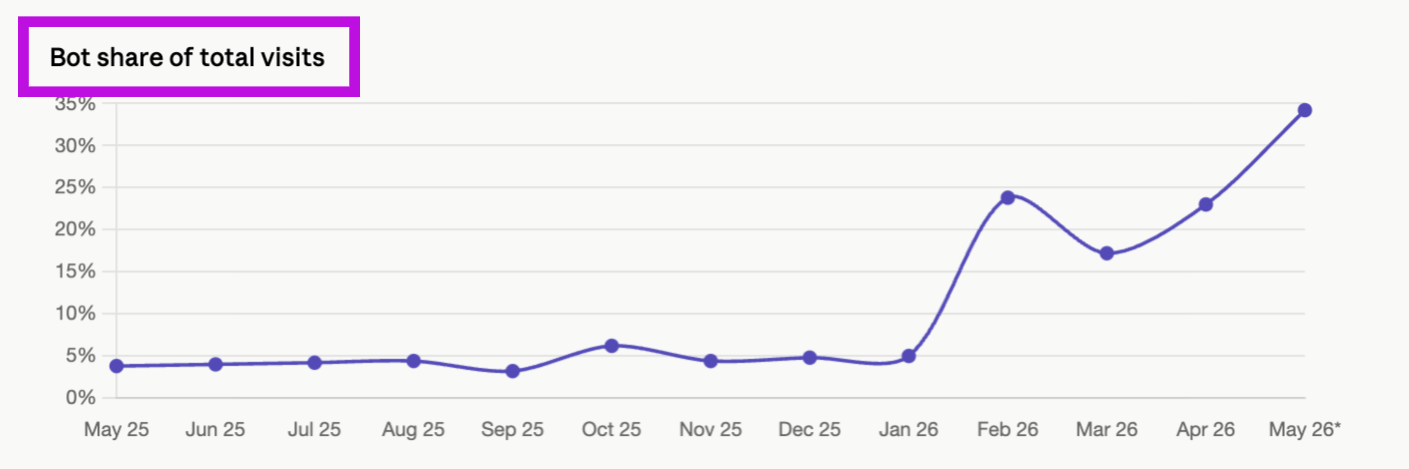
For the past twenty years, small business owners in Connecticut have built their websites for one audience: people. That assumption no longer holds. On many of the sites we monitor at Develomark , AI bots now account for roughly 35% of all traffic — meaning for every ten visitors a Hartford County business receives, only six and a half are human.

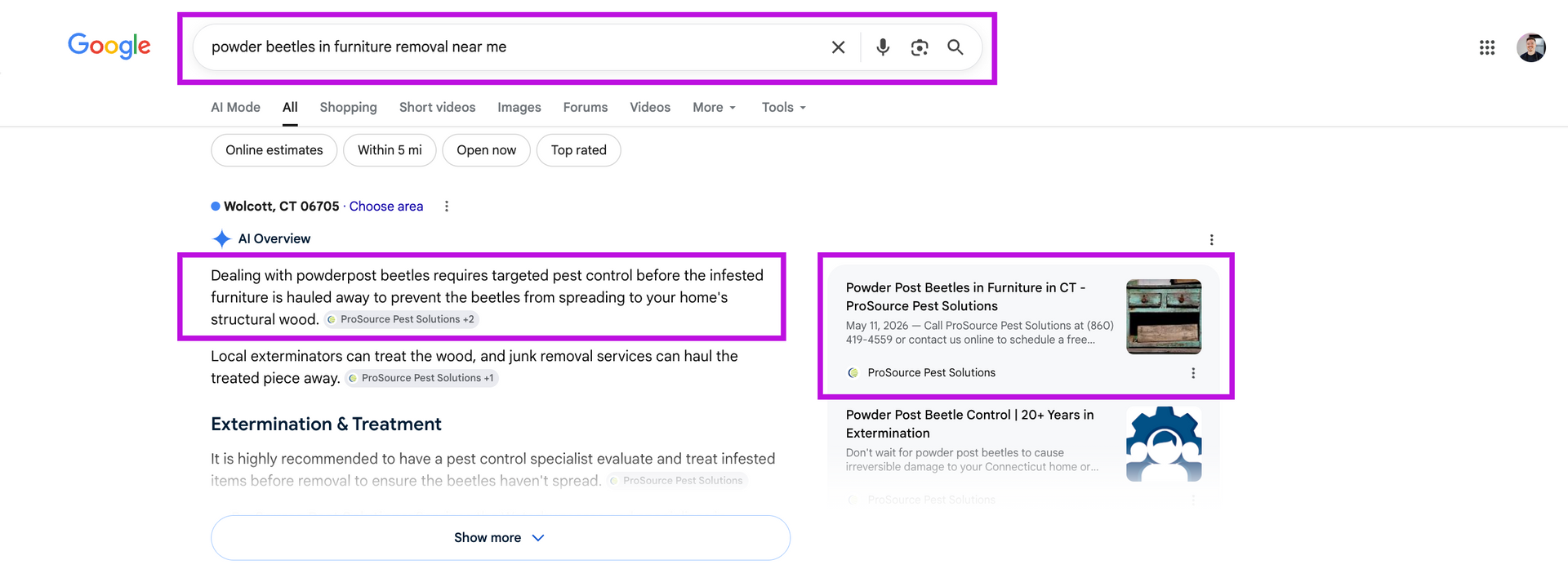
That shift changes what a website actually needs to do. It still needs to convert humans, but it also needs to be readable, citable, and recommendable to ChatGPT, Claude, Perplexity, Gemini, Google AI Overviews, AI Mode, and Grok. If those systems can't understand your site, they won't recommend your business — and the customer never finds you in the first place.

This guide walks through what's changed, why it matters for service-based businesses across Connecticut, and how Answer Engine Optimization (AEO) gets your business cited in AI-generated answers.

The New Reality: Your Website Has Two Audiences

Line chart labeled

When a potential customer in Plantsville, West Hartford, or Cheshire searches for a service today, two things happen in parallel. A human eventually evaluates your website visually — your photos, your reviews, your offer. But long before that, an AI agent crawls your site, parses your content, and decides whether your business is worth recommending in the answer it serves the user.

The robot looks at structure. The human looks at design. If your site only satisfies one, you lose the other.

Bots Are No Longer a Rounding Error

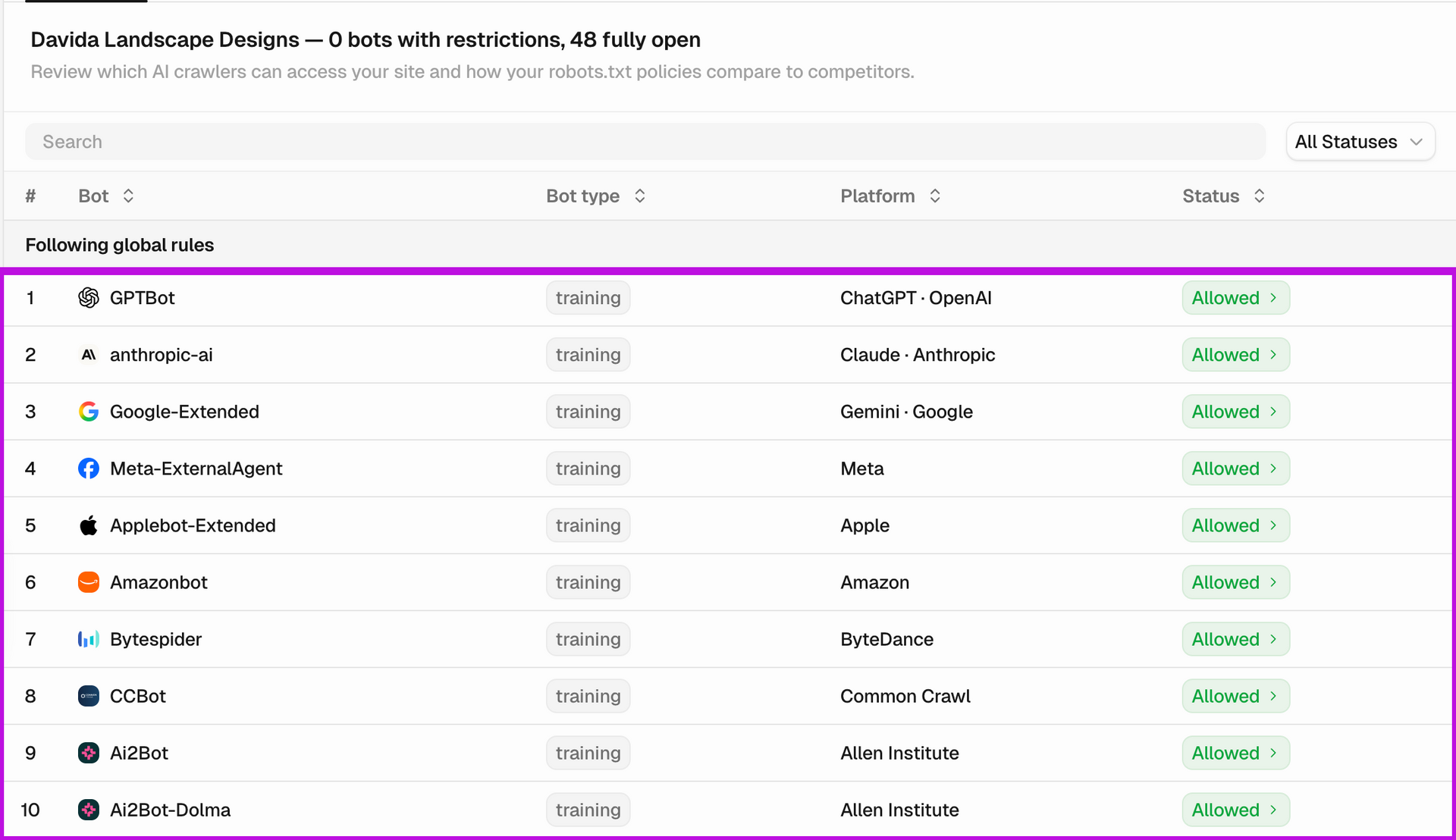
Spreadsheet-like admin table with app icons and green status labels, highlighted by a magenta border

Cloudflare's public bot traffic data shows that AI crawlers from OpenAI, Anthropic, and Google have grown into the dominant non-human traffic on the web. On a typical Develomark client site, bot visits jumped from a small share of traffic in mid-2025 to roughly a third of all sessions by mid-2026. Industry forecasts now suggest more than half of all internet traffic will be automated by 2027.

For a Connecticut service business, that means a meaningful portion of your "traffic" isn't browsing — it's indexing. Each of those crawls is a chance for your business to be cited in the next answer ChatGPT or Perplexity gives to a real customer in your service area.

What AI Bots Actually Look For

Checklist-style list of tasks with status labels and dates in a white dashboard interface

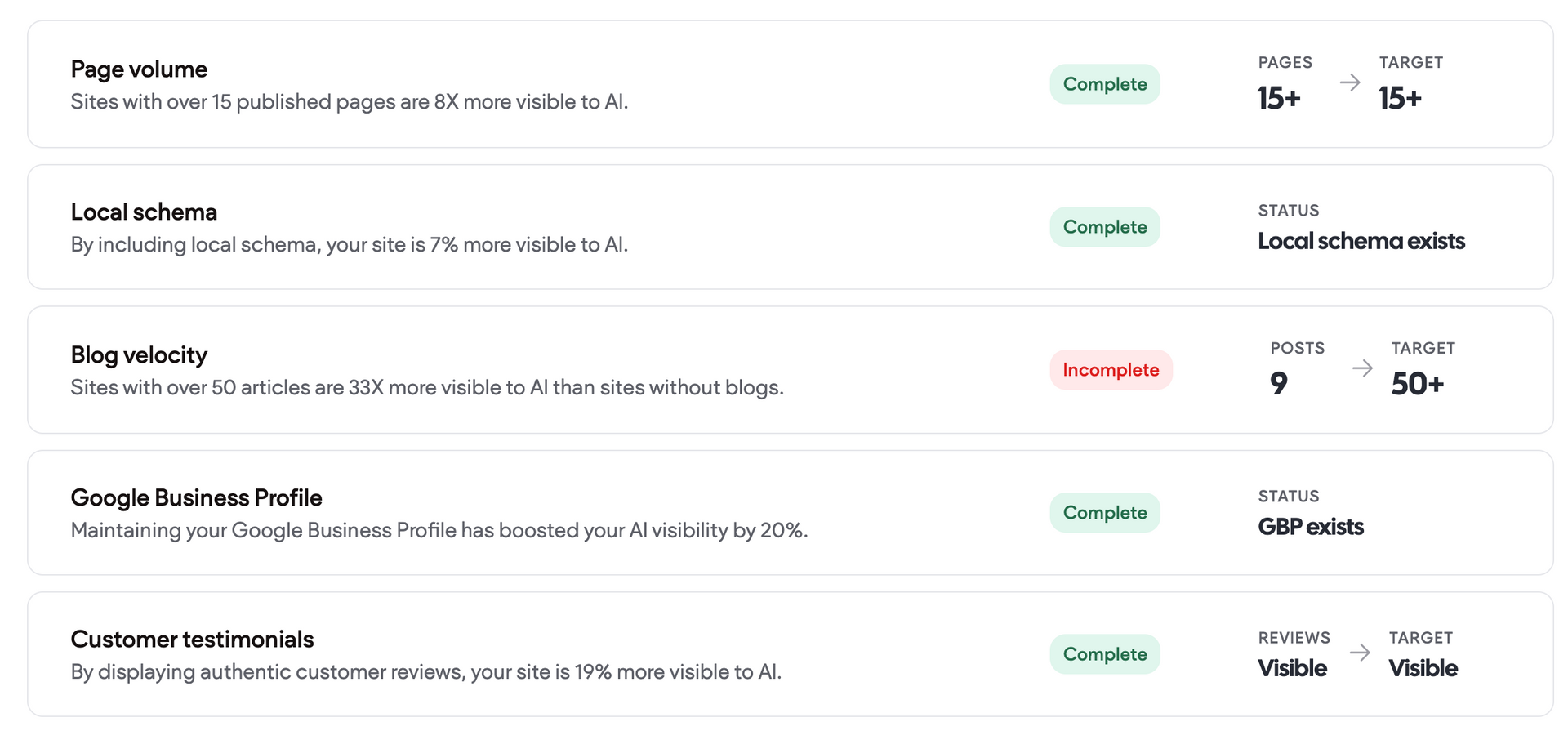
AI engines reward sites that are easy to parse and clearly localized. Based on the patterns we see across our Connecticut client base, the highest-impact signals are:


  • Page volume. Sites with more than 15 well-structured pages are roughly 8x more visible in AI search than thin sites.
  • Schema markup. Structured data improves AI visibility by an additional ~7%.
  • Active blogging. Sites publishing consistent, intent-driven posts see dramatically higher citation rates than sites with stale blogs.
  • NAP consistency. Your name, address, and phone number — listed identically on your Google Business Profile and across the web — lifts AI visibility by around 20%.
  • Authentic, on-site reviews. Real customer language gives LLMs the social proof they use to qualify recommendations.

Why "Just Do SEO" Isn't Enough Anymore

Traditional SEO was built for ten blue links and a top-three ranking. AI search has collapsed that into one recommendation. When a customer asks ChatGPT for "the best landscape designer in Stamford" or "a reputable pest control company in Hartford County," the LLM is usually surfacing one business at the top — and then a short list of citations most users never click.

SEO still matters. But AEO is what determines whether you're the business named in the answer.

How AI Engines Decide Who to Recommend

Screenshot of a task list app with a left panel highlighted in pink and a summary panel on the right

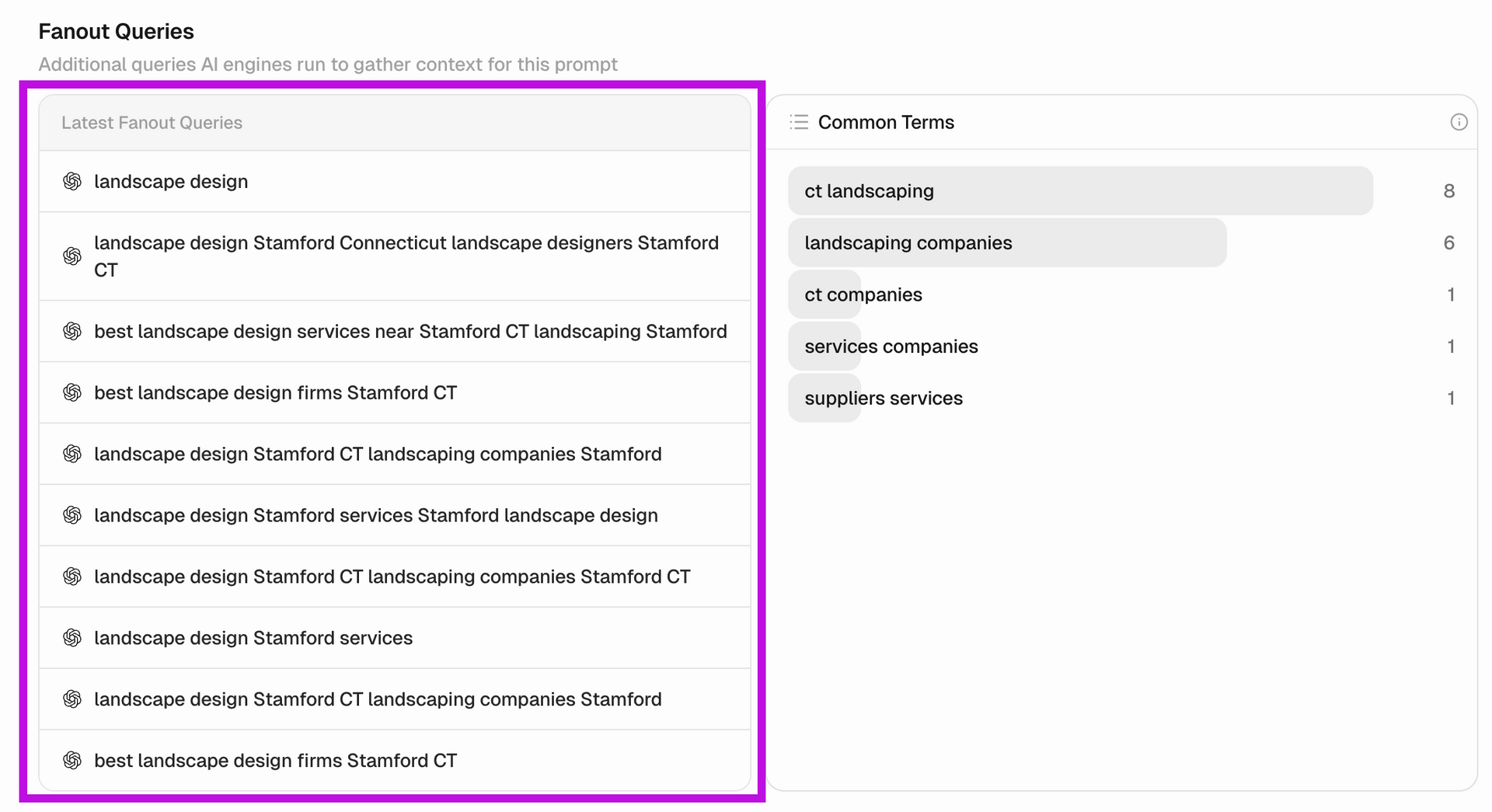
When someone types a single search like "landscape designer Connecticut" into ChatGPT, the model doesn't run one search. It quietly fans out into roughly ten related queries simultaneously — comparing landscape designers, looking at reviews, checking service areas, pulling pricing context, and reading individual website pages. This is called query fan-out , and it's the single most important concept for AEO.

If your website only answers the obvious keyword, you'll miss the dozens of underlying questions the AI is actually evaluating. The businesses that win in AI search are the ones whose websites already answer the fan-out — not just "landscape designer" but "how much does a Connecticut landscape designer cost," "what's the difference between a landscape designer and a landscape architect," "do you serve Fairfield County," and so on.

Measuring AI Visibility in Connecticut Markets

Dashboard line chart showing two trends, blue and orange, with small KPI metrics above.

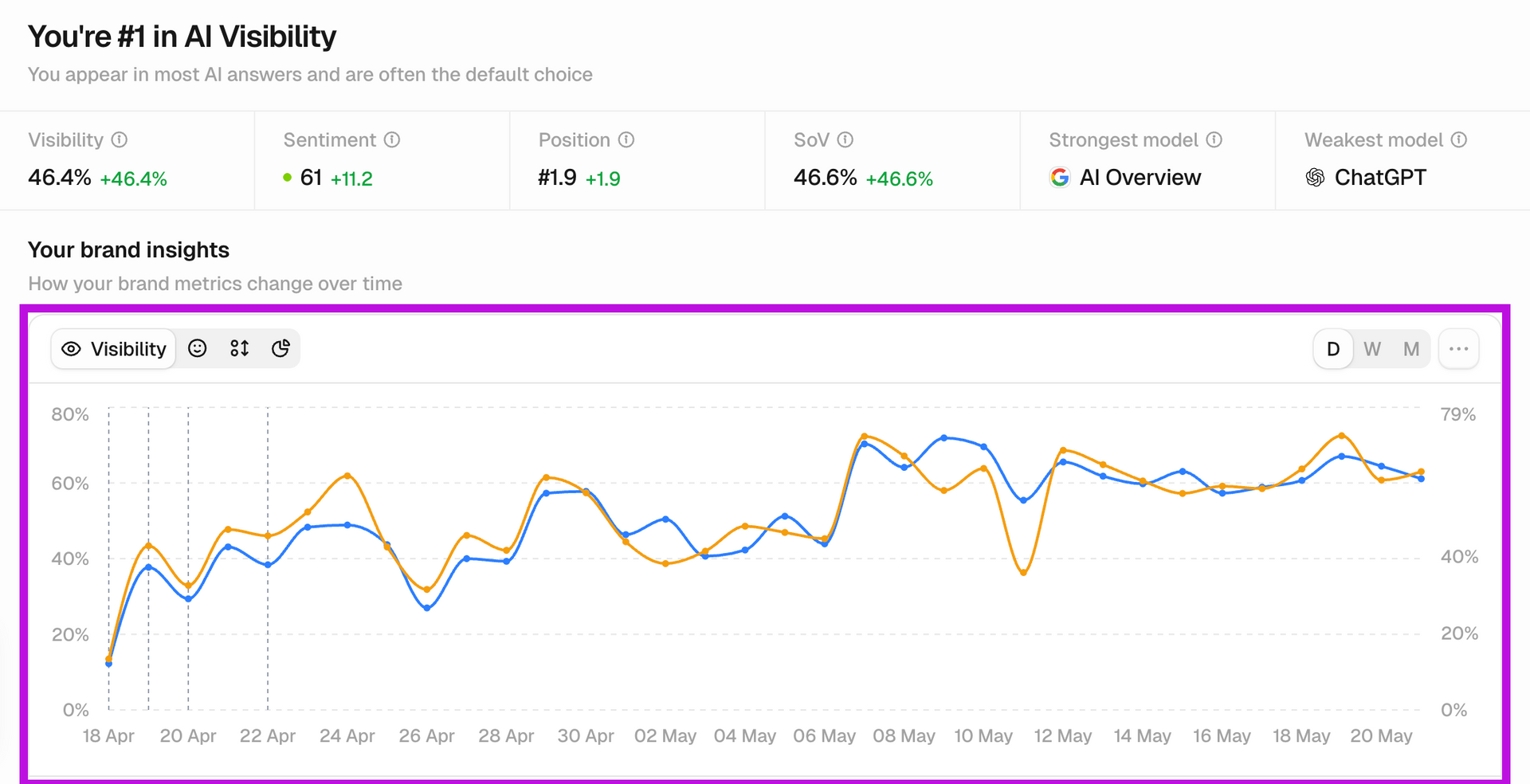
We track AI visibility across about 50 simulated prompts per client, every week, across every major LLM. For one Connecticut client, that monitoring shows their business cited in roughly 85% of relevant AI responses — with AI Mode and Google AI Overviews as their strongest channels and ChatGPT as the weakest. That kind of channel-level visibility tells us exactly where to invest content next.

Most agencies still don't measure this. If you can't see your share of voice across LLMs, you can't improve it.

Real Connecticut Examples
Analytics dashboard with timeline, line charts, and highlighted notification card in the center.

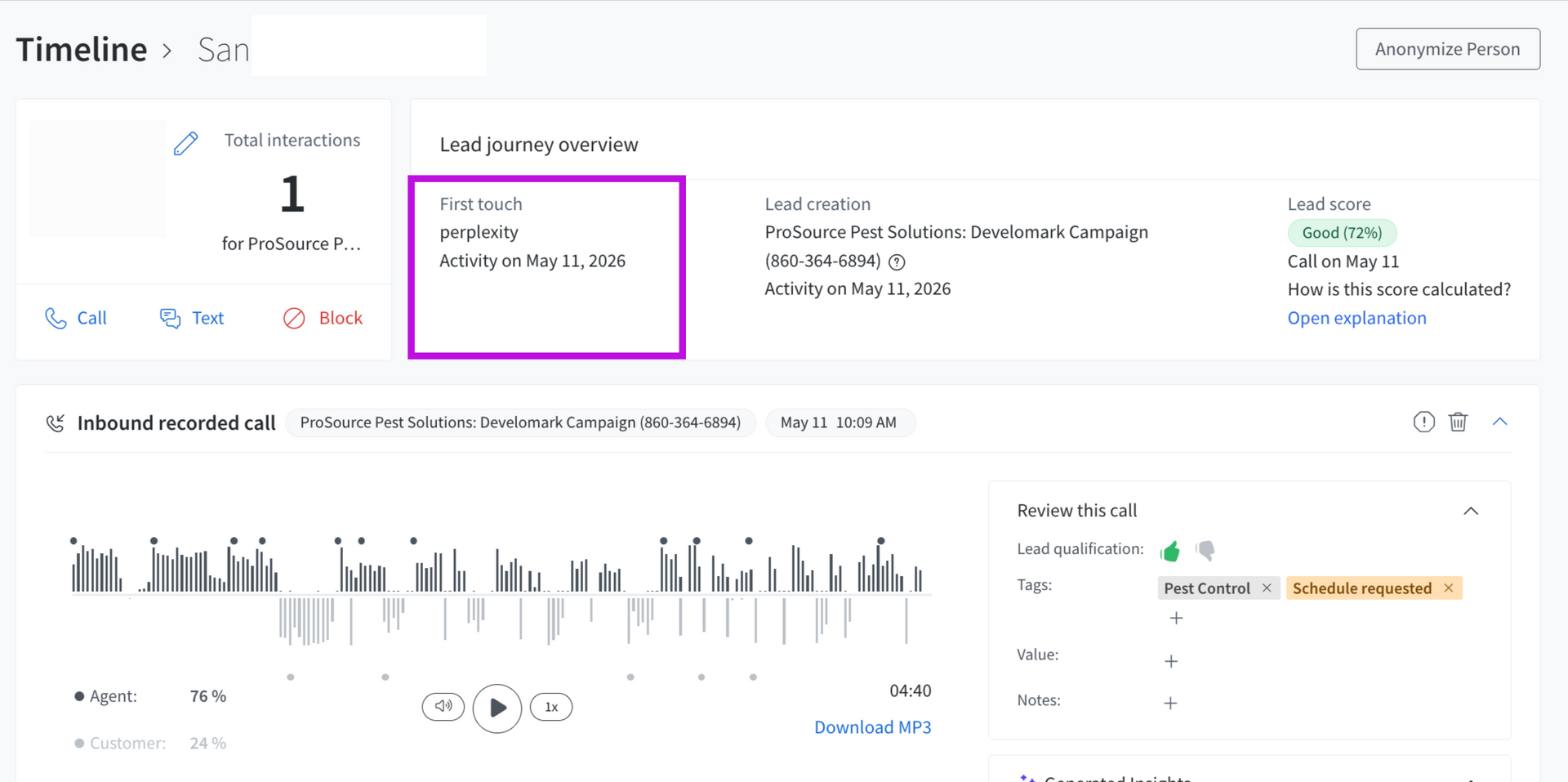
This isn't theoretical. We've tracked leads from Perplexity into a Connecticut service business with a 72% lead score, ChatGPT-sourced form submissions on a kitchen remodel, a tattoo shop booking new clients through AI referrals, a tree company recommended by an AI assistant as the top option in its service area, and dental implant patients researching through ChatGPT before booking. The pattern is industry-agnostic — manufacturing, home services, dentists, and creative businesses are all seeing it.

How Develomark Builds AEO for Connecticut Service Businesses

Our approach is built around one principle: real customer conversations become website content faster than any agency can write it by hand. We use automation to turn phone calls, form submissions, and emails into intent-driven pages indexed within 24 hours.

A recent example: a customer called one of our pest control clients asking whether they could sell a home with active carpenter ants. We transcribed the call, ran it through our knowledge base, generated a localized article — "Selling Your Home With Carpenter Ants: Warranty Timeline Guide" — and published it on the client's site. The page was indexed the next day and immediately began ranking in AI results. Total human effort: a quality-control review. No agency could write, edit, and publish that fast under a billable-hour model.

That's the workflow behind every AEO engagement we run — pulling real intent from your business and turning it into machine-readable, locally-relevant content at scale.

What This Looks Like For Your Business

For most Connecticut service businesses we work with, AEO unfolds in four stages: a visibility baseline across the major LLMs, a content automation system tied to your actual phone calls and form data, technical optimization (schema, page speed, internal linking), and weekly visibility tracking with clear share-of-voice reporting. You see what's moving, what isn't, and where the next page needs to go.

Frequently Asked Questions

What's the difference between SEO and AEO?

SEO optimizes your website to rank on traditional search engine results pages. AEO optimizes your website so AI engines like ChatGPT, Claude, and Perplexity cite your business directly in their generated answers. Both matter, but AEO is what determines whether you're recommended when someone asks an AI for a service in Connecticut.

How long does AEO take to show results?

Faster than traditional SEO. AI engines re-index content quickly — we've seen new pages cited within 24 to 48 hours of publishing. Measurable visibility shifts across a 50-prompt set typically appear within 30 to 90 days.

Do I need a Connecticut-based agency to do AEO?

You need an agency that understands your service area. Local context — Hartford County zip codes, town names, regional language — is exactly what LLMs use to qualify businesses for local recommendations. We're based in Plantsville and work with service businesses across Connecticut, which means our content is built around the way your customers actually search.

Ready to Be the Business AI Recommends?

If you're a Connecticut service business and you're not currently being cited in AI-generated answers, you're losing customers who never see your name. The fix isn't another blog post per month — it's a system that turns your real customer conversations into content the bots can read, understand, and recommend.

Book a free AI visibility audit with Develomark and we'll show you exactly where your business stands across ChatGPT, Claude, Perplexity, and Google AI Overviews — and what it takes to get cited in the answer.

European performance car in a clean service bay, illustrating an AEO and SEO website case study
By Develomark June 29, 2026
How Develomark built an AEO and SEO optimized website for a Connecticut European car service shop—FAQ schema, keyword headings, dynamic pages, and AI search wins.
Checklist icon and papers with bold text “YOUR DATA + AI SEO” and a green upward arrow on a pink background
By Develomark May 26, 2026
Your AI search visibility is only as strong as the data behind it. Learn how Connecticut service businesses use customer calls, forms, and a real knowledge base to win AEO.
Two people in a bright therapy office, seated and talking with microphones and notebooks.
By Develomark May 19, 2026
Learn how a transcript-first culture helps Connecticut small businesses rank in AEO, AI search, and Google. Practical tools and steps you can start using today.
Portrait of Ava Creto with text: “Winter 2026 Developmark Cohort #2 Ava’s Experience,” Cheshire, CT
By Develomark May 10, 2026
Learn how Ava gained hands-on experience with SEO, AEO, client communication, ad campaigns, and strategy through Develomark’s marketing cohort program.
Winter 2026 title slide featuring Patryk Niciewicz, Plainville, CT, with portrait and “Developark Cohort #2” text
By Develomark May 10, 2026
Discover how Patrick used Develomark’s cohort program to gain experience with AI tools, client work, advertising, and entrepreneurship-focused marketing skills.
Portrait of Sam Church beside text: “Develmark Cohort #2: Sam’s Experience” and “Winter 2026”
By Develomark May 10, 2026
Learn how Sam used Develomark’s cohort program to expand from graphic design into client communication, advertising, strategy, and real-world agency experience.
Trainee in white jacket beside text: “Developr Cohort #2: Tralee’s Experience” and “Winter 2025”
By Develomark May 10, 2026
Learn how Develomark’s cohort program helped Tralee gain hands-on experience with SEO, AEO, content creation, client communication, and real marketing strategy.
Learn how Develomark helps businesses succeed in AI search with AI SEO, AEO, and GEO strategies that
By Ruan Marinho April 25, 2026
Learn how Develomark helps businesses succeed in AI search with AI SEO, AEO, and GEO strategies that drive visibility and trust.
By Ruan Marinho April 19, 2026
Learn how recent Google updates, AI search trends, and new tools like ChatGPT ads are impacting local businesses—and what you should do to stay competitive.
Four people stand under blue and green billboards reading “Bats?” and “Bugs?”
By Ruan Marinho April 19, 2026
Discover how Develomark used AI image generation to design high-impact billboards for a real client, improving speed, creativity, and results.
Show More